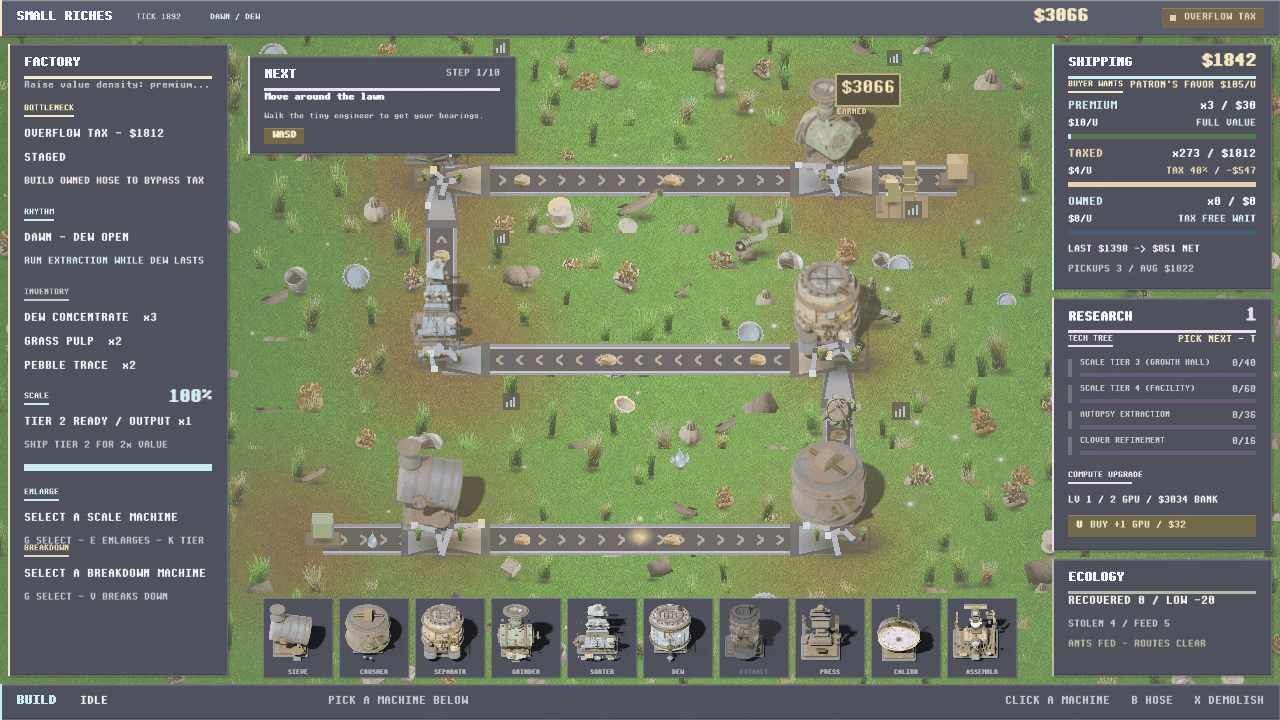
Screenshots are development captures. Benched until 3D asset generation is fast and cheap enough at the scale this needs; re-tested on each model release.
Small Riches is a scale-magic engineering factory game: you’re a tiny engineer building a dense automated factory in the grass, around one impossible scale core, for a patron who is paying suspiciously well. Crush grit, condense dew, separate sap, press stabilizer, then ship goods by value density, because when you’re this small, what fits in the hose matters more than what you made.
Why it exists
I love factory games, but I wanted one with a physical premise that changes the optimization problem. At backyard scale, logistics is intimate: belts thread between grass blades, lawn ants are an ecology-level threat, and “enlargement” (literally scaling things up with the core) is a research milestone, not a menu upgrade. The design pillars run scale-magic first, factory capitalism second, mystery-patron flavor close behind.
Highlights
- A complete playable loop: place machines from a build palette, wire belts and loaders, unlock research-gated recipes, perform your first enlargement, and sell through owned delivery hoses to scheduled buyer pickups.
- 11 production machines (crusher, grinder, grit sieve, dew condenser, sap separator, micro assembler, and more), every one with multi-frame Blender-authored working animations.
- A value-density shipping economy with a six-tier goods ladder, plus lawn-ant ecology pressure nibbling at the edges.
- Factory, scaling, economy, rhythms, and ecology logic extracted as reusable headless kernel crates, all deterministic: no wall clock, no unordered iteration in the sim.
- 16 product golden fixtures and byte-identical capture-determinism canaries keep the sim honest; versioned saves migrate across releases.
- A Blender-first 2D sprite pipeline with silhouette readability gates and a byte-stable 4096² atlas.
Technical approach
Small Riches vendors my RTS Engine as substrate but deliberately rejected 3D: a 3D vignette prototype failed its visual gate, and the shipping client is engine-rendered 2D sprites drawn in a single draw-list submit. The interesting engineering lives in the headless kernels: the whole factory sim runs and regression-tests without a renderer, and an AI-play harness drives eight seeded factories through 1,200-tick sessions against a hard performance budget. Around 152k lines of Rust with over a thousand tests across the workspace.